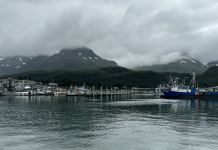
Harvest from the Copper River drift gillnet fishery grew to 1.1 million salmon this week, predominantly sockeyes, and the overall Prince William Sound catch rose to 3.5 million fish.
The retail supply of Copper River sockeye fillets was getting smaller, with prices as low at $12.95 a pound at Fred Meyer stores in Anchorage where they sold out, and up to $37.95 a pound for premium portions at FishEx, an online Anchorage retailor. Pike Place Fish Market in Seattle was advising consumers to call for availability of those Copper River reds at $34.99 a pound, and whole Copper River reds, averaging four pounds, for $89.96 per fish.
The Alaska Department of Fish and Game (ADF&G) put the estimated statewide catch on July 9 at more than 25 million salmon, including 20.8 million sockeyes, 3.7 million chum, 439,000 pinks, 110,000 Chinook and 6,000 cohos.
The Eshamy District drift/setnet fleet had more than one million fish as well, including 970,000 sockeyes, 54,000 Chinooks, and 4,000 pink salmon. The Prince William Sound general seine district brought in 709,000 fish, including 667,000 chum and 38,000 sockeyes. The Coghill District drift fleet had a total catch of 235,000 fish, including 165,000 chum, 68,000 sockeyes and 2,000 humpies.
In Bristol Bay, harvesters in the Nushagak District had a total catch through July 9 of 8.2 million salmon. The Egegik District had 3.1 million fish and the Naknek-Kvichak District another 3 million.
For the Ugashik District the catch to date was 2 million salmon and the Togiak District had 71,000 salmon.

In Cook Inlet the catch has reached 228,000 salmon, mostly sockeyes from Upper Cook Inlet.
Southeast Alaska commercial salmon harvests have reached more than 2 million fish.
The Copper River catch also includes a total of 27,000 chum, 6,000 Chinooks and 3,000 humpies.
“While the Alaska statewide salmon harvest remains below 2023 year-to-date, the rate of harvest accelerated last week as the expected peak week for sockeye harvest approaches,” said Sam Friedman a consultant for McKinley Research Group LLC. “This peak usually occurs in early July.”
Friedman produces weekly in-season updates on the commercial salmon fisheries in Alaska on behalf of the Alaska Seafood Marketing Institute (ASMI).
“In Bristol Bay, the world’s largest sockeye salmon fishery, the harvest of 14 million fish is down 34% from year-to-date 2023,” he said. “However, the harvest picked up last week with about 11 million fish caught, most in the Nushagak and Naknek-Kvichak districts.”
Friedman noted that ADF&G reported last week that Bristol Bay sockeye have been smaller and younger than expected this year, what with more fish returning after only two years in the ocean. “Smaller fish are better able to swim through nets, reducing harvests, and yield smaller filets,” he said.
Southeast troll-caught salmon, by comparison, have been larger this year compared to 2023, according to preliminary fish ticket data for this year and region. Chinooks caught there have averaged 11 pounds — 5% higher than in 2023. Southeast keta salmon have been weighing in at 9.9 pounds on average, 25% higher than last year, and cohos are weighing in at 4.8 pounds, or 12% bigger than a year ago.