Part I
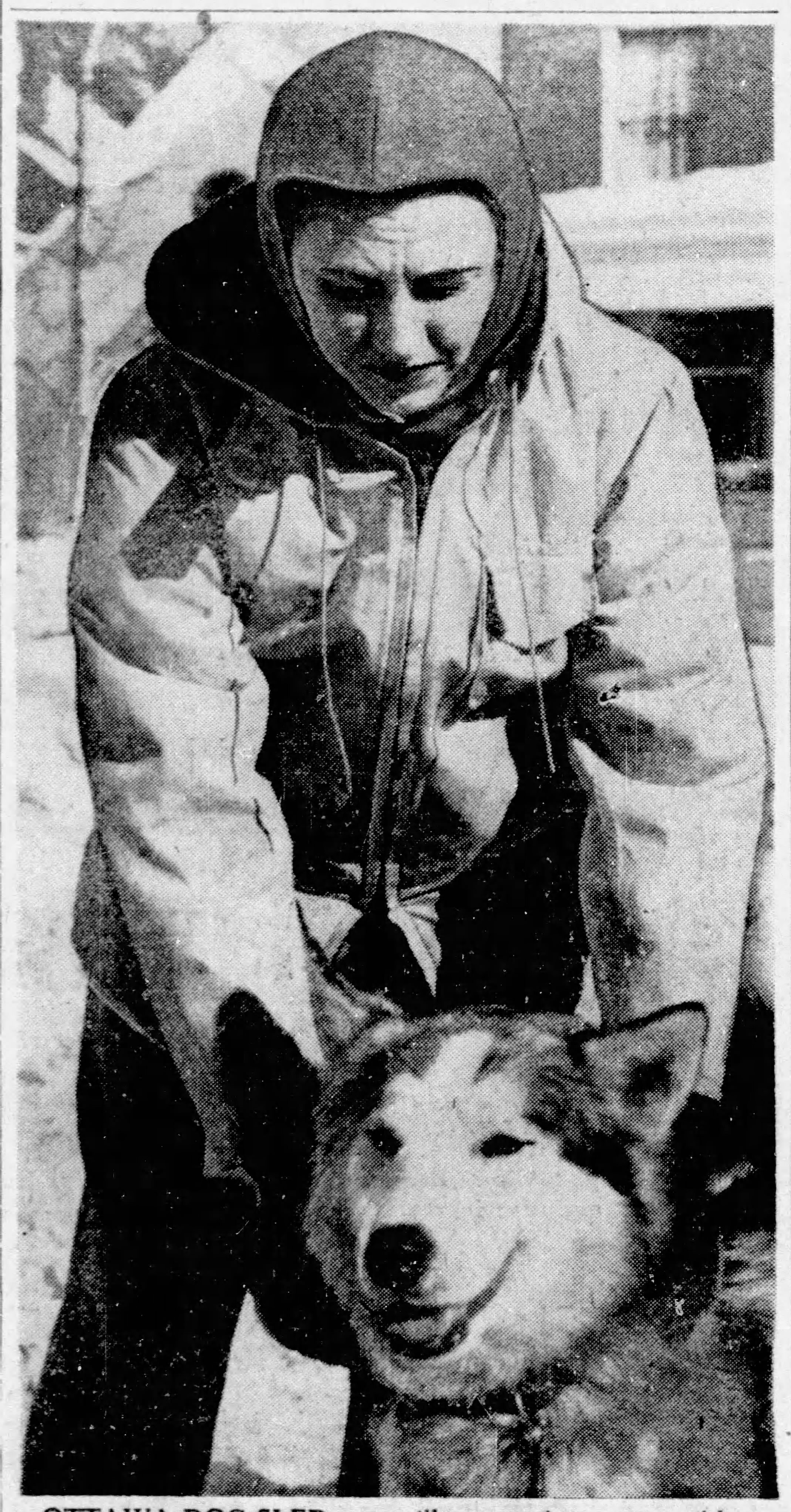
At his office in Massachusetts, Dr. Roland Arnold Lombard was regarded as the veterinarian of choice for the city’s dog and cat owners.
In Alaska and Canada and other parts of New England, however, he was known as the musher to beat whenever he and his dog teams came to compete in a big race.
Dr. Lombard was born in Maine on Sept.17, 1911. As a boy, he approached legendary Alaskan Leonhard (“Leonard”) Seppala, a Norwegian-born musher who often gave public talks about his involvement in the much-ballyhooed 1925 serum run by dogsled to Nome.
Seppala was also a competitive musher and three-time winner of the pioneering All-Alaska Sweepstakes.
The boy confided his dream of one day becoming a musher.

“Seppala told me something about how to train the dogs, and he gave me two old collars for the necks of the dogs,” the boy told a sports reporter back then. Lombard then and later spoke with a pronounced “Back East” accent.
Encouraged by his hero, the thin, slightly built Lombard took up the sport, entering a race at age 15 at Laconia, New Hampshire. He built a sled and harness by hand and began training one dog at first.
Lombard found a partner next. He trained with a dog-crazy neighbor named Charles D. Brown. The two gathered their courage and traveled to New Hampshire to seek advice from Arthur T. Walden, a musher who was about to join Admiral Richard Byrd on his first Antarctic Expedition.
Before long, their team was up to five mongrels. Lead dog Chip was part mastiff and part shepherd. Bob and Rinso were German shepherds. Buck was a collie. Wolf was shepherd and collie.
Lombard built up their strength and endurance by running alongside them, riding the sled only when he thought they were ready and the trail was nice and easy.
At 16, in 1928, he competed at the annual sled-dog races at Poland Spring, Maine, against several experienced mushers with veteran matched teams of dogs. He didn’t win but he left his mark.
“Sixteen-year-old Roland A. Lombard Proved Sensation at Poland Spring Derby,” noted a headline in the Portland (Maine) Press on Feb. 5, 1928.
He also won a $1,500 purse at Poland Springs and took time away from the sport to attend college.
Following graduation, he again competed in New England races but like many mushers, stopped racing during the years of World War II.
By 1948 he renewed his old competitive spirit. He was married to his wife Louise who shared his love for the sport. His handler was Colonel Norman Vaughan who had accompanied Byrd and Walden on that two-year Antarctic expedition.
Vaughan served as another valuable mentor for the husband-wife mushers.
That year he was regarded as one of the top New England-based competitors in the sport, according to the Nome Nugget. By this time, his dog teams were made up of Siberian huskies.
“We (he and Louise) have given up all our other hobbies – and some of our vices – in order to concentrate on our dogs,” Lombard told a Montreal Star writer.
His competitive wife may have been devoted to him, and she was, but not when both were in a race.
You see, Louise Lombard was a competitor who brought a team of her own to face off against his dogs and anyone else’s.
Today, long after the victories of Libby Riddles and Susan Butcher, few race aficionados are surprised when a female shows up on a sled. But when Louise and her team competed against Doc Lombard and a lineup of male drivers at the three-day, 90-mile “grind” during the Ottawa winter festival in February 1949, “there was a lifting of eyebrows among veteran sourdoughs” over such a thing, according to the Nome Nugget.
Around this time, mutual friends introduced Louise and him to Alaska musher Earl Norris, the winner of the 1947 and 1948 Fur Rondy competitions. Norris and his wife persuaded the couple to test their skills by entering races in Alaska and Canada. Like the Lombards, the Norrises were passionate about the Siberian breed.
“We were after him for several years to come up,” Natalie Norris told the Anchorage Daily News. “We wanted to prove what Siberians could really do.”
At last, Doc. Lombard and Louise agreed to try their luck in Far North races in Alaska and Canada.
The rest is history. Next week we’ll cover some of that history.
Hank Nuwer teaches journalism as an adjunct professor at the University of Alaska Fairbanks.