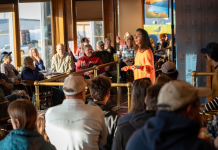
U.S. Sen. Lisa Murkowski, R-Alaska, had money on the brain during last weekend’s town hall, when she spoke with Cordovans about federal funding that impacts the city.
The June 8 town hall marked the culmination of Murkowski’s two-day trip to Cordova, where she was set to attend a few one-off meetings with locals, as well as attend the annual Prince William Sound Science Center’s (PWSSC) Copper River Nouveau fundraiser.
At Mt. Eccles Elementary School on Sunday morning, the senator began the town hall by speaking about the federal Fiscal Year 2025 Reconciliation Bill – also dubbed the “One Big Beautiful Bill” by President Donald Trump – which is currently being considered in the U.S. Senate. The bill is an annual piece of legislation that sets priorities and makes changes to the country’s operating budget.
Murkowski told the crowd of around 60 Cordovans that she thinks the bill is “aggressive” in terms of its attempts to cut federal spending.
“There’s a very aggressive schedule to do some very aggressive things in this policy within this reconciliation bill,” she said. “I think it can be big or it can be beautiful, but it can’t be both.”
The senator spoke at length about the dangers of proposed cuts to social programs, such as Supplemental Nutrition Assistance Program (SNAP) and Medicaid – the joint federal and state program that provides health insurance for low-income individuals, including those with children and disabilities.

“Many of us are looking at that and saying, it makes no sense to put a greater burden on the most vulnerable in our communities when it comes to healthcare and access to healthcare,” she said. “I have made clear very early on that we cannot move forward with a bill that makes cuts to Medicaid.”
Murkowski indicated she would support a statewide Provider Tax to make up for potential Medicaid cuts – which is a tax imposed on healthcare providers by the state with the goal of providing additional Medicaid programs without increases to local taxes. Alaska is the only state without the Provider Tax in place, Murkowski said, and something that she says she wants to change.
Murkowski did, however, say that she sees some positive aspects of the bill – including the focus on military security. According to the senator, the legislation would provide funding support for aviation, polar ice breakers and more cutters. In addition, she underscored the extreme importance of the Coast Guard to the state of Alaska – specifically due to the state’s vast coastline and challenging geography.
“There could not be a greater investment in our Coast Guard than what we see in this reconciliation bill,” Murkowski said.
Murkowski added that while federal appropriations in the reconciliation bill might be focused on larger industry overall, her recent reintroduction of the Working Waterfronts Act is designed to target smaller communities like Cordova. She highlighted the importance of harbor upgrades, marine lifts, and workforce development – which she said should be addressed within coastal communities to keep their working waterfronts viable.
The Working Waterfronts Act focuses on coastal energy, the seafood sector, and ocean-based technology innovations, she said. That the bill can also take advantage of related executive orders, according to Murkowski.
“I think it dovetails with the administration’s focus on ships and shipbuilding because you can’t do that without those communities that are there supporting them,” she said.
The senator also discussed the hyper-local fiscal landscape with residents – including the ongoing financial woes at the city level and the Cordova School District.
Murkowski said she recognizes the difficult situation that many smaller communities are in when it comes to uncertainty about school funding, even noting the Cordova City Council’s recent “hard decision” to increase the property tax rate to try to help with the school district’s budget shortfalls.
“There are some things I don’t like in this reconciliation bill, but one of the good things you should know is there is a two-year fix to Secure Rural Schools (funding),” Murkowski said.
But with Republican Gov. Mike Dunleavy’s expected line-item veto on Alaska’s public education funding, the senator also recognized the immediate uncertainty to Cordova School District funding.
“This problem is the timing of all of this, you have decisions that you have to make in regards to your school…So how do you piece that together while you’ve got this delay in federal funding?” Murkowski said.
Apart from federal funding discussions, the senator extended her praise to various Cordova entities – including the hydropower efforts by Cordova Elective Cooperative, PWSSC’s recent monitoring research, and the work of local healthcare administrators.