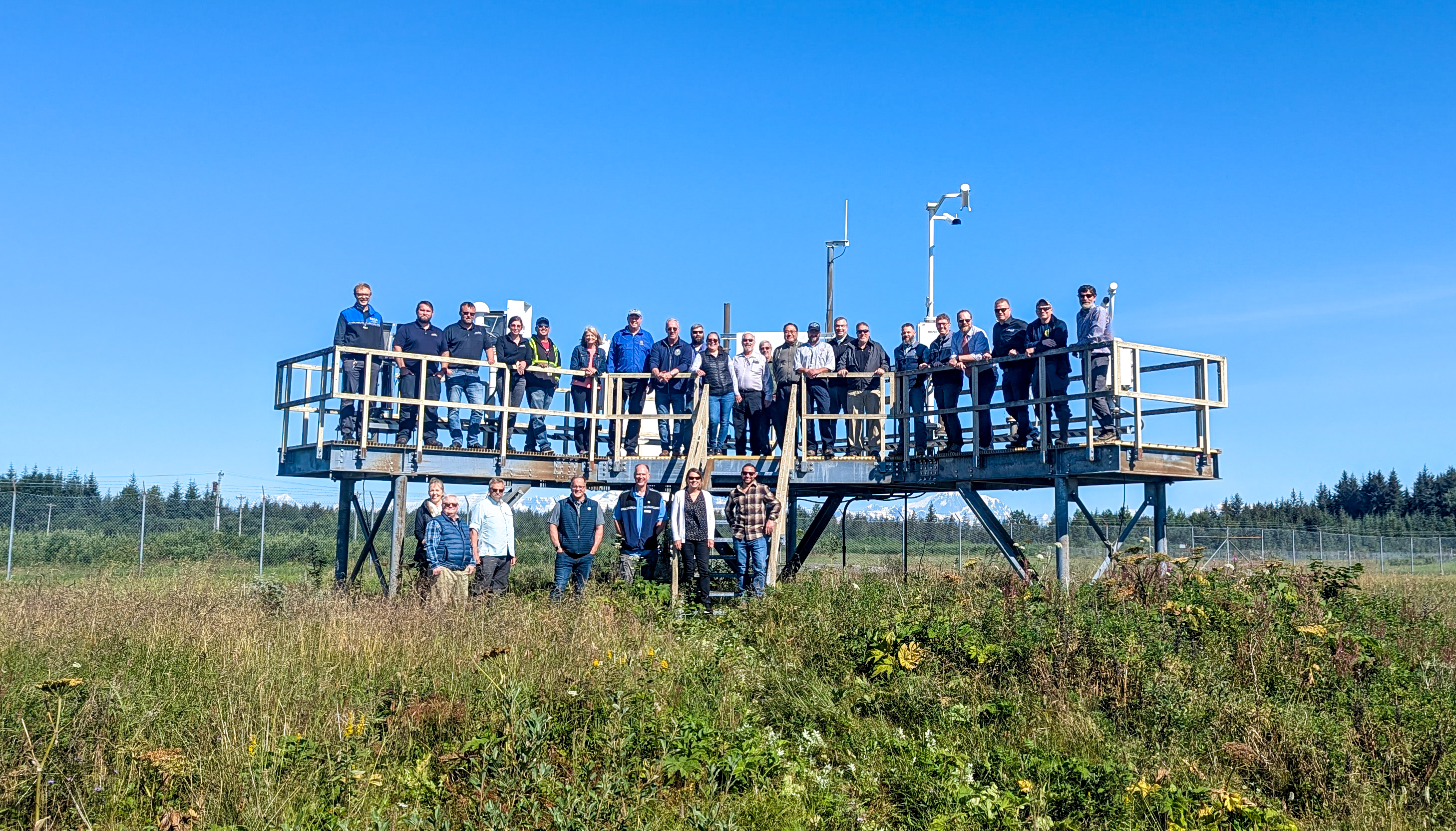
Alaska communications and aviation entities, together with related federal and state officials, convened in a summit in Yakutat led by Sen. Lisa Murkowski, R-Alaska, to collaborate on solutions to reduce travel delays and boost aviation safety in the state.
“We have 130 weather recording stations in Alaska and at any given time 50 % are partially or entirely out of service,” Murkowski said on Aug. 15. The senator, third generation Alaskan born and raised in Ketchikan, is out to resolve this issue, which has resulted in so many canceled flights in and out of rural communities.
“Earlier this year, I experienced what many rural Alaskans are all-too-familiar-with, a long delay that forced me to redo my travel plans after Yakutat’s Automated Surface Observing System (ASOS) suddenly went down,” Murkowski said. “As I learned more about the tangled management responsibilities of multiple federal agencies overseeing Alaska’s aviation weather reporting systems, it became obvious there have to be system improvements and greater communication between all stakeholders.
“This summit allowed us to drill down to the core of the issue and work on solutions,” Murkowski added. “This conversation is just the beginning in ensuring that all agencies and stakeholders are working together to ensure safer and more reliable air travel not only in Yakutat, but across the state.”
During the roundtable discussion, several steps to address the issue at Yakutat were identified, including having a community resident become the local weather observer as a part of the Non-Federal Weather Observation (NF-OBS) Program.
Expanding remote repair capabilities as connectivity improves is expected when Cordova Telephone Cooperative’s microwave network comes online in October. Other steps include establishing battery backup and power conditioning systems, and moving forward with a project to consolidate Yakutat’s three ASOS system components in one location with a singular backup power supply. The group also discussed improving collaboration across agencies, and policy changes necessary to address the persistent weather sensing issues experienced across Alaska.

Yakutat Airport is a focal point for statewide weather observation challenges critical to the Don Young Alaska Aviation Safety Initiative (DYAASI) and improvements in aviation safety, Murkowski said.
Earlier this year, the 2024 Federal Aviation Administration (FAA) Reauthorization established DYAASI to include three specific weather reporting priorities:
- – A 2030 deadline for installation of certified weather technology;
- – Holding the FAA administrator responsible for reliability of certified weather systems in Alaska and requiring within two years a “weather system reliability and restoration plan for the state “to include telecommunications connection reliability and the available maintenance parts and staff;”
- – And creating a process and requirement to deploy additional weather cameras, while requiring consultation with government and airspace users for deployment location.
Jeremiah Beckett, CEO of Cordova Telecom Cooperative (CTC), said the company is on track to have services up and running at Yakutat by Thanksgiving, weather dependent.
“The construction in Yakutat is almost done and the microwave towers along the Lost Coast are nearing completion,” Beckett said.
He noted that many of the plants are “antiquated,” running on diesel generators.
“It sounds like the power system is from World War II and the FAA did not have backup batteries and generators,” he said. “The airport does have backup power, but the FAA is not connected to it. We offered to donate our battery bank when we turn off our satellite network, and that would help alleviate stress on their power system.”
Beckett also applauded the idea of training and certifying weather observers for Yakutat.
“It takes a few months of training, and they have to get certified and be FAA approved, but it would be a tremendous benefit to the community and all of us who fly on the Milk Run,” he said.
In August of 2023 CTC announced that it had been awarded $34.9 million in grant funds from the U.S. Department of Agriculture’s Rural Utility Service ReConnect Round 4 program to install a submarine fiberoptic cable from Cordova to Juneau — the goal being to deliver Fiber-To-The Home in the unserved community of Pelican, with additional fiber branches to Yakutat, Gustavus and Hoonah. With CTC’s match of $11.6 million that resulted in a community investment of $46.5 million.
CTC noted that the project, code named “FISH in SEAK” (Fiber Internet Service Homes in Southeast Alaska) would deliver broadband internet speeds of 100/20 megabytes per second with gigabit potential to all year-round residents.
The ReConnect Program is an innovative program that offers unique federal financing and funding options in the form of grants, loans and loan/grant combinations to facilitate broadband deployment in areas of rural America that don’t have sufficient access to the internet.
CTC is a member-owned local co-op serving the telephone, high-speed internet, television, and technology needs of the community of Cordova since 1978. Founded in 1997, Cordova Wireless provides cellular voice, text, and data services to Cordova, as well as Prince William Sound fishing grounds and Yakutat, Alaska.