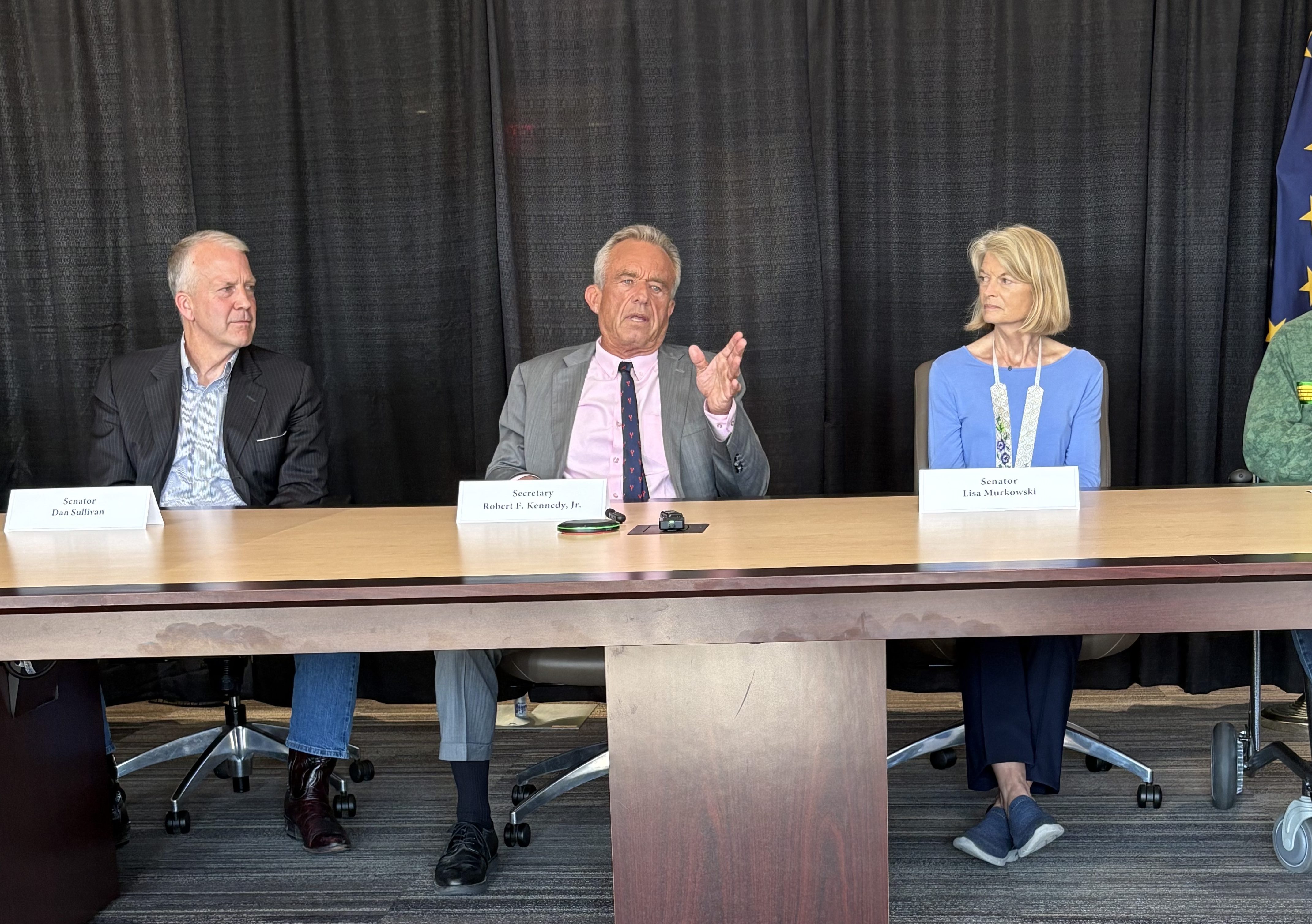
U.S. Health Secretary Robert F. Kennedy Jr.’s office announced a $500 million funding cut for mRNA vaccine research on Aug. 5, before emphasizing his concerns over the safety of some vaccines during a news conference at the Alaska Native Tribal Health Consortium (ANTHC) in Anchorage.
“We support vaccination, but what we’re doing is to make sure the vaccines are adequately tested and that we get the best, safest vaccines available to Alaskans and every American,” Kennedy said. “The mRNA vaccines, we know from COVID, don’t work against upper respiratory infections. They don’t work very well – let me put it that way.”
As he spoke in a conference room inside ANTHC, several dozen people picketed in protest on the sidewalk outside the building, with signs saying “Autism Is Not A Disease, But RFK Jr. Is,” “Rage Against Billionaires,” “Respect the Science. Vaccine saves lives,” and more.

Prior to the late afternoon news conference in Anchorage, the federal Department of Health and Human Services, at Kennedy’s direction, withdrew the $500 million earmarked for mRNA vaccine research. Kennedy has been critical of mRNA vaccines and has canceled projects led by pharmaceutical firms like Pfizer and Moderna, which produce vaccines to protect people against the flu, COVID-19 and H5N1.
In a video posted on social media, Kennedy said that “to replace the troubled mRNA programs, we’re prioritizing the development of safer, broader vaccine strategies, like whole-virus vaccines and novel platforms that don’t collapse when viruses mutate.”
Kennedy appeared at the news conference alongside Republican Sens. Lisa Murkowski and Dan Sullivan – both of whom voted to confirm him earlier in the year – as well as leaders of ANTHC.

Besides COVID-19, mRNA technology is currently being explored for vaccines against influenza (flu), respiratory syncytial virus (RSV), and cytomegalovirus (CMV). Many of these mRNA vaccines are in early stages of development.
Murkowski, sitting to Kennedy’s left at the news conference, declared herself “a strong believer that vaccines save lives, as I believe the secretary himself has stated.” But Murkowski also criticized Kennedy for his decision to replace every member of the Advisory Committee on Immunization Practices (ACIP), which is commonly made up of medical and public health experts who provide guidance on effective control of vaccine-preventable diseases.
“I have been critical of the fact that the ACIP board was basically terminated and a new group of individuals was installed because I feel that that challenges the credibility of the advisory board itself,” she said. “So I have been one who has been perhaps more critical of some of the processes. But I don’t fault the secretary for wanting to ensure that there is a more rigorous testing process for our vaccines, although I do believe that we have many vaccines that have been in place for years, if not decades, that have clearly demonstrated that efficacy over a period.”
Sullivan declined any comment on Kennedy’s views on vaccines.
A day earlier in Anchorage at her own news conference, Murkowski discussed a wide range of topics – including her concerns over National Weather Service funding cuts, the loss of funding for the Denali Commission, and confirmation delays for nominees to the U.S. District Court in Alaska.
She also defended her crucial vote earlier this summer on the Republicans’ spending package – legislation referred to by President Donald Trump as the “Big Beautiful Bill.”
“I did everything within my power as one lawmaker from Alaska to try to make sure that the most vulnerable in our state would not be negatively impacted,” Murkowski said. “I had a hard choice to make, and I think I made the right choice for Alaskans.”
During the day of press appearances, Murkowski didn’t confirm whether she’s considering a run for governor – as has been speculated by some Alaskans.
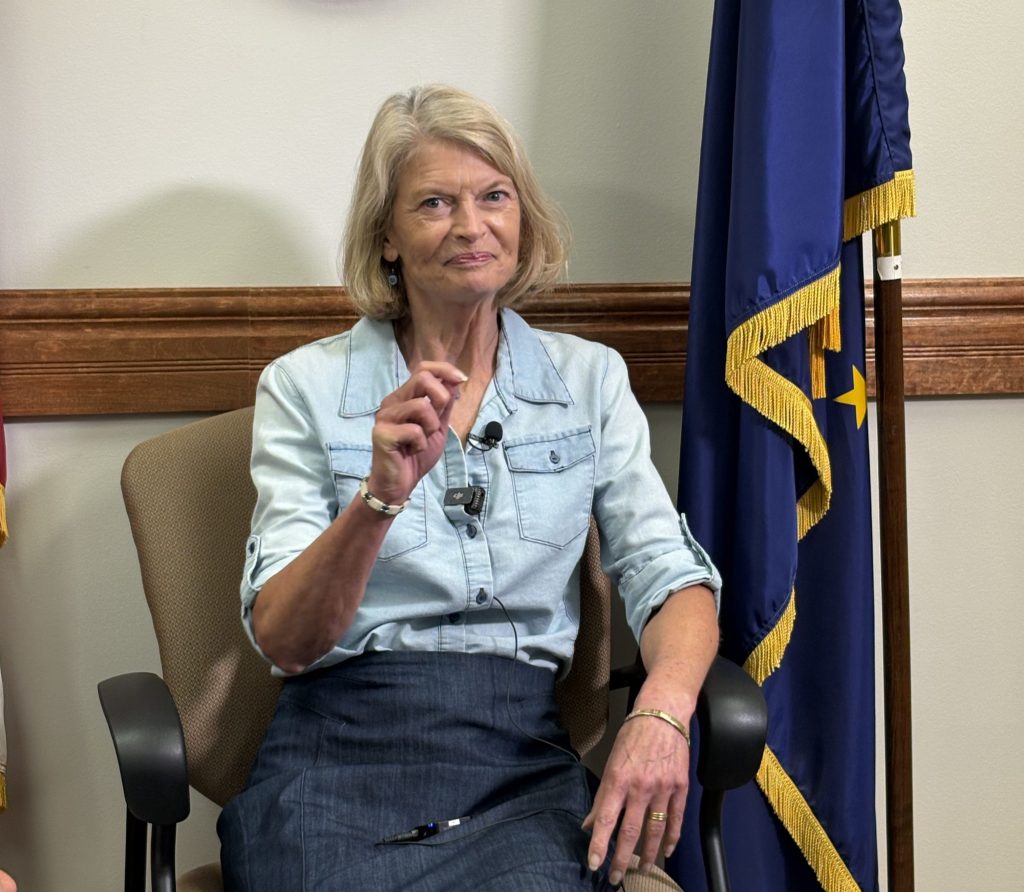
“I would love to come home,” said Murkowski, who makes it clear in her new autobiography, “Far From Home,” how much she misses Alaska while serving as the state’s senior senator in Congress.
“I am not making any decisions about anything because my responsibility to Alaskans is my job in the Senate right now,” she said.
Murkowski has served in the U.S. Senate since 2002, when her father Frank Murkowski appointed her to his former seat after winning the race for governor of Alaska.
After losing to Joe Miller in the 2010 Republican primary election, Murkowski was encouraged by Republicans and Democrats to stay in the race. She ran a successful write-in campaign, one of the most successful in recent history, securing her seat in the Senate once more.
She is next up for reelection in 2028.