By Kristin Smith
In a community where people often shake their heads and say “Cordova splits 50/50 on every issue,” we are all, actually, aligned on the value of Cordova’s waterfront lands. I think it’s safe to say we strongly agree that they are priceless! We are all deeply proud of Cordova’s commercial fishing heritage, with generations of families having benefited from fishing. And so many of us, including our hard-working cannery crews, draw a deeper breath as we stroll along the water to gather our thoughts or unwind a little.
It can be hard to turn this value into a shared vision for the future, though, and that is what the City Council, Planning & Zoning Commission, Parks & Recreation Commission, and Harbor Commission are working toward now. On July 2, the City Council voted to issue a Request for Proposals (RFP) for the breakwater fill lot.
How did we get to an RFP, and what does this step mean?
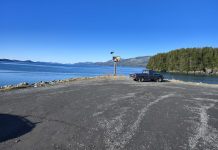
The city’s breakwater fill lot, created initially to break up the north swell wave energy and keep it from damaging the outermost finger floats, has been considered for several different additional uses since it was created in 2012 – ranging from a science nonprofit facility to private tourism/retail uses to seafood processing to open, recreational space.
Following the most recent letters of interest submitted in early 2024 (which were not bids or development proposals), and after the city learned that its third application for funding to re-develop the north harbor uplands was rejected (in fall 2024), the city held a mug-up session to hear from residents about their preferred uses for the breakwater fill lot. Residents also were invited to comment via an online survey, to which there were 106 responses.

Broadly, the survey responses showed support for:
- Covered public gathering/recreation space (41 responses);
- Generate city revenue/economic development (28);
- Maintain open/public access and views (25);
- Mixed use: Public space + business/revenue (14);
- Tourism (8);
- Infrastructure improvements (7);
- Leave as is, no change (6);
- Miscellaneous or non-specific (4).
Note that the survey responses aren’t cumulative – that is, each person could have indicated that she or he supported more than one of those ideas for use of the lot. All the responses above tally to 133 responses, greater than the 106 total responses submitted. More detail on the survey results is available on the city’s website (see the council packet for the July 2, 2025 meeting at cityofcordova.net).
Another piece of the waterfront planning puzzle is work being done by the Parks & Recreation Commission in partnership with the Covered Spaces Project. Together they have created a conceptual rendering of a recreation area developed on the edge of the south fill, adjacent to the Breakwater Trail. Uses pictured for this area include a three-sided, covered structure and picnic tables. These uses are consistent with preferences expressed by the public in the 2013 South Fill Project Summary, which also called for a walkway around the perimeter of the South Fill.
A majority of the City Council voted to request proposals for uses on the breakwater fill lot because they wanted to see what the choices might be, what ideas might be submitted – and really, the range of possibilities is broad.
The council will have the option to sell some or all of the lot. It could lease some or all of the lot. A sale or lease could be entered into with one or more businesses, one or more nonprofits, perhaps a group of committed residents, or portions of the lot to each of those entity types. Considerations discussed by the council include construction and maintenance costs (regarding recreation, the city is focused on maintaining the pool and re-building Skater’s Cabin), harsh weather in that location, a desire to see what ideas are put forward, and a concern for falling city revenues.
Proposals for the breakwater fill lot are due Aug. 29, 2025. Proposals submitted will first be reviewed by the Planning & Zoning Commission at its Sept. 9, 2025 meeting, which will then make a recommendation to the City Council.
For centuries, waterways had been treated as dumping grounds. Many communities literally turned their backs – the backs of buildings and factories – to rivers, lakes and the ocean. We are now turning our full attention on this valuable resource and working to make careful decisions about how to make the most of this limited resource.
Kristin Smith was elected mayor in March 2025.