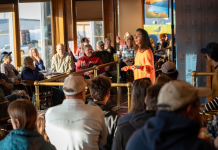
Speaking recently to a conference of nonprofit entities in Alaska, Sen. Lisa Murkowski, R-Alaska, told them “We are all afraid.”
Her comment went viral, and many interpreted it to mean fear of retaliation from President Donald Trump’s administration.
In an interview published in the May 22 edition of the New York Times Sunday Magazine, the Alaska Republican explained.
“I didn’t say we’re all afraid of retaliation. I did say we’re all afraid because I was in a room of about 500 nonprofits, many of whom had received notices that their grants had been canceled or frozen,” Murkowski said. “There was just so much uncertainty. Were they going to lose their employees? Were they going to be able to continue to provide services for vulnerable women and kids? Were they going to be able to continue to build out that small hydro project so that they could finally get that village off diesel? Everybody was on edge.”
They needed an honest answer and that’s what they got from Murkowski – whom the Times describes as the last of a dying breed of politicians, someone who prefers to eschew bombast and speak softly with deliberation.
While Murkowski has acknowledged she has never voted for Trump, she said she has worked with him to expand oil and gas exploration in Alaska. Her power lies in the fact that she is courted by both Democrats and Republicans for her support, according to the Times’ report.

Still, Murkowski told the conference, where her comment went viral, that “we are all afraid of what may be coming next because we do not know.” Then she told them that retaliation is real, “which wasn’t news to anybody because people were seeing that … and so I acknowledged what people were feeling. And it made the news.”
In her new book “Far From Home,” due out from the publisher around the end of June, the senator writes about how she learned to adapt to the harsh climate of the nation’s capital and urges a move to political grounded in compromise and compassion.
She told the New York Times: “I think what has happened is we are not only more accepting of confrontational behavior, we are expecting it. When did we cross that threshold where it is now OK to be wholly partisan, I mean, wholly, wholly partisan? We used to celebrate bipartisanship. Now you’re fraternizing with the enemy.”
The Times asked Murkowski if she is worried about the nation’s democracy and she responded that “we as Americans should always be worried about our democracy.”
At this time, she said, she is talking with a lot of people who are asking her if it’s just their imagination or if the equilibrium is so out of balance, that the country cannot regain it.
“I refuse to believe that we are not able to regain it,” she said. “But I think it’s dangerous for us in the legislative branch right now, when we are not standing up for our roles under the Constitution, and we effectively cede to the executive.”
Overall, Murkowski said, she wants to be there to represent the people of Alaska. She acknowledged that she finds herself in a spot where, in an effort to just tell it like it is, people are looking to her for answers in different areas that she had not anticipated.
While this is not something she welcomes, “if I can do right by Alaska, speaking as I feel is right and appropriate and timely, that’s what I’m going to do,” she said.