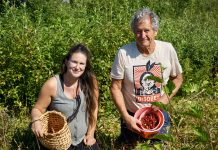
Renowned Alaska Native chef Rob Kinneen, who grew up in Southeast Alaska, is featured in the Feb. 19 edition of Civil Eats – an online publication that reports on the American food system.
Highlight of his career to date for Kinneen include preparing an Alaskan dinner for former President Barack Obama, coordinating a two-day feast for hundreds of people at the 2023 White House Tribal Summit, and cooking for a week in the remote Arctic National Wildlife Refuge with the Wilderness Society.
Kinneen currently serves as outreach director for chef Sean Sherman’s nonprofit North American Indigenous Food Systems, and is a commissioner of the U.S. Indian Arts and Crafts Board.
As noted by article author Kate Nelson, an award-winning Tlingit woman writer and editor, Kinneen – who live in Durham, North Carolina – pitched in his culinary skills last October when Hurricane Helene caused severe damage in Appalachia.
He drove to the small town of Swannanoa with an apron and a knife, reached the commissary kitchen and began cutting up vegetables.
“It was second nature for him to jump in to help,” wrote Nelson.

Kinneen has dedicated much of his professional life to sharing his knowledge of Alaska foods, with a focus on local, sustainable ingredients and educating the public on the benefits of these foods.
Kinneen helped at that commissary kitchen for many days, preparing large amounts of roasted squash and cabbage-apple slaw to be shared with braised beef and pork. He told Nelson “even though we were just weeks out from a catastrophic event that washed away people’s homes, there was still this uplifting sense of community and camaraderie. It’s a good reminder that food relief, which has become increasingly political and bureaucratic, is really about basic humanity.”
Given the exorbitant cost of groceries, particularly in rural Alaska, Indigenous communities rely heavily on subsistence hunting and fishing and the gathering of fresh foods, from berries to kelp and black seaweed, beach asparagus and more.
Kinneen also noted that, with 95% of Alaska’s food imported, that residents need to learn the value fathering local foods.
Born in Petersburg, Kinneen moved with his family to Anchorage as a teenager. Given his passion for becoming a chef, and the influence of a culinary instruction, Kinneen went from Anchorage to the Culinary Institute of America after finishing high school, then on to work in restaurant kitchens from Louisiana to North Carolina for 15 years before returning to Alaska for 15 years.
Most recently Kinneen has organized Indigenous-focused festivals for hundreds of people.
“While Tlingit ancestral knowledge is rooted in tradition, that doesn’t mean it can’t be adapted,” he told Nelson. “We should be mapping today’s thought processes and technology onto Indigenous stewardship models to help promote food knowledge.”