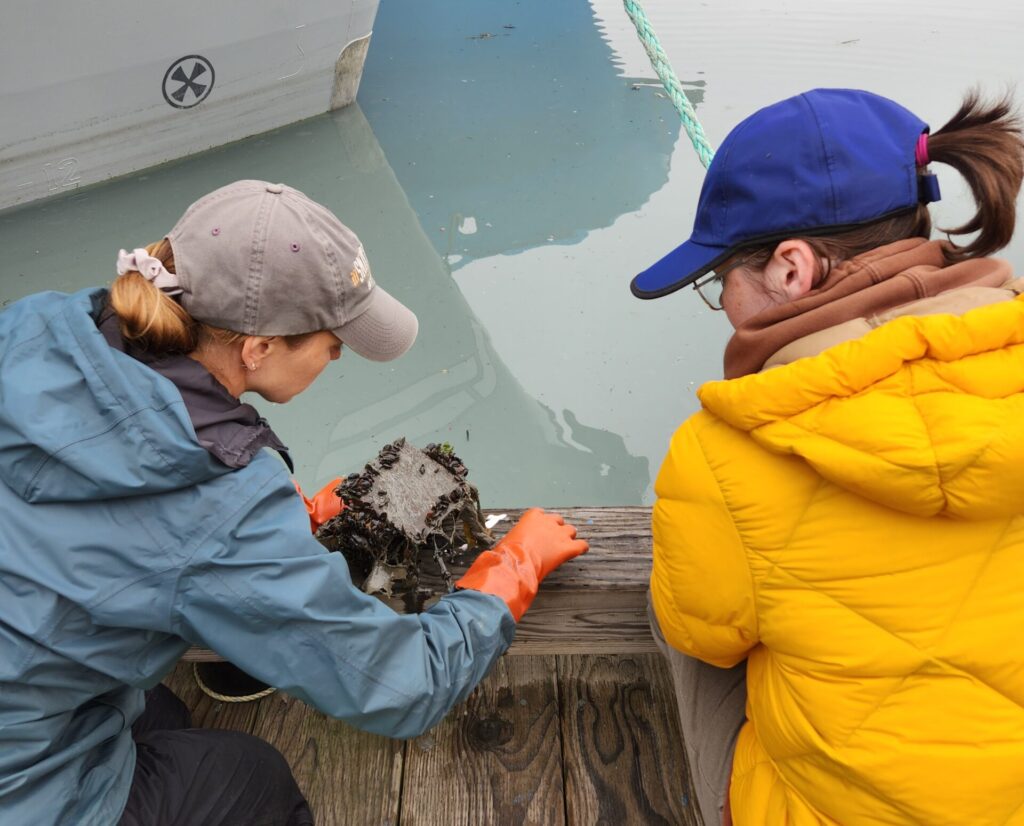
Scientists from the Smithsonian Environmental Research Center (SERC), in partnership with the Prince William Sound Regional Citizens’ Advisory Council (PWSRCAC), have identified new non-native benthic marine invertebrate species in Prince William Sound.
Researchers detected three non-native species during the survey conducted in 2023, the PRWRCAC said in a report issued on Nov. 22. It was the largest survey of non-native benthic marine invertebrate species in Prince William Sound since 2003.
They identified two crustaceans – their technical names Caprella mutica and the Monocorophium acherusicum – and another small invertebrate (bryozoan), called a Schizoporella japonica. One of the three, the Schizoporella japonica, had been detected previously, but the other two were determined to be new to Prince William Sound. Another new non-native species, a marine worm called Ciona savignyi, was found by volunteers for the PlateWatch program – a separate monitoring program also sponsored by the Smithsonian. This tunicate has now been reported in both southeast Alaska and Prince William Sound.
“Our goal is to support early detection,” said Danielle Verna, environmental monitoring project manager for the PWSRCAC.
Verna emphasized that monitoring programs are important, since non-native species can have environmental impacts to new areas.
“They can out-compete our native species and generally disrupt the ecosystem,” she said. “That is why we are supporting early detection and monitoring projects like this one.”

Verna, who joined the council staff in April 2021, is responsible for coordinating projects with the council’s scientific advisory committee. She holds a doctorate in environmental science from Portland State University, a master’s degree from Alaska Pacific University, and a bachelor’s degree from the U.S. Coast Guard Academy. Her work is focused on invasive species dynamics related to commercial shipping.
PWSRAC has been supporting invasive species research in Prince William Sound since the early 2000s, most of it with SERC. The council also participates annually in PlateWatch, with research done statewide.
In the Prince William Sound area, the council even participates through internships with high school students in Cordova and Valdez.
“It’s a great opportunity for them to learn about their marine environment, and it contributes to the citizen science monitoring program and part of a much broader network,” Verna said.
In the case of these new non-native species, she said it could be a battle for resources in Prince William Sound.
“The concern is that they take up space in resources, such as food and disrupt the ecosystem,” she said.
Non-native marine species travel from region to region in several ways, the report notes. Some species can travel on their own as adults, others have larvae that can drift with the tides.
Species that don’t naturally travel far on their own can also migrate through either tanker ballast water or hull fouling. Ballast water is sea water taken into the hold of a ship, such as an oil tanker, to help stabilize the vessel while traveling. If the water is released into the destination port with no prevention measures, larvae of these species can grow and become established in the new port. Hull fouling, on the other hand, is when a marine species like a barnacle or tunicate attaches itself to the outside hull of a vessel.
Many of the tankers that call at the Valdez Marine Terminal in Prince William Sound come directly from ports along the Pacific coast. One of these, San Francisco Bay, has more than 300 non-native marine species, more than any other estuary in the world.
Fortunately, the tanker companies that visit Prince William Sound have been installing management systems that treat ballast water during the trip to reduce the number of organisms released in local waters. The hulls are also covered in special paint that discourages tunicates and barnacles from attaching – another system to help prevent the spread of non-native species.
Evidence of the Ciona savignyi was found using genetic analysis on a single settlement plate in southwest Prince William Sound. The report noted that this marine worm could be of concern, as it has caused damage to oyster populations in locations where it has invaded. Further evaluation is needed to confirm this identification, however.
PWSECAC officials said that the survey brings the total number of non-native benthic marine invertebrate species confirmed in Prince William Sound to seven. The species Schizoporella japonica and Mya arenaria – a clam originally from the east coast of the United States – are confirmed to be established in the area. Researchers do not know if any of the other five are established, the report said.