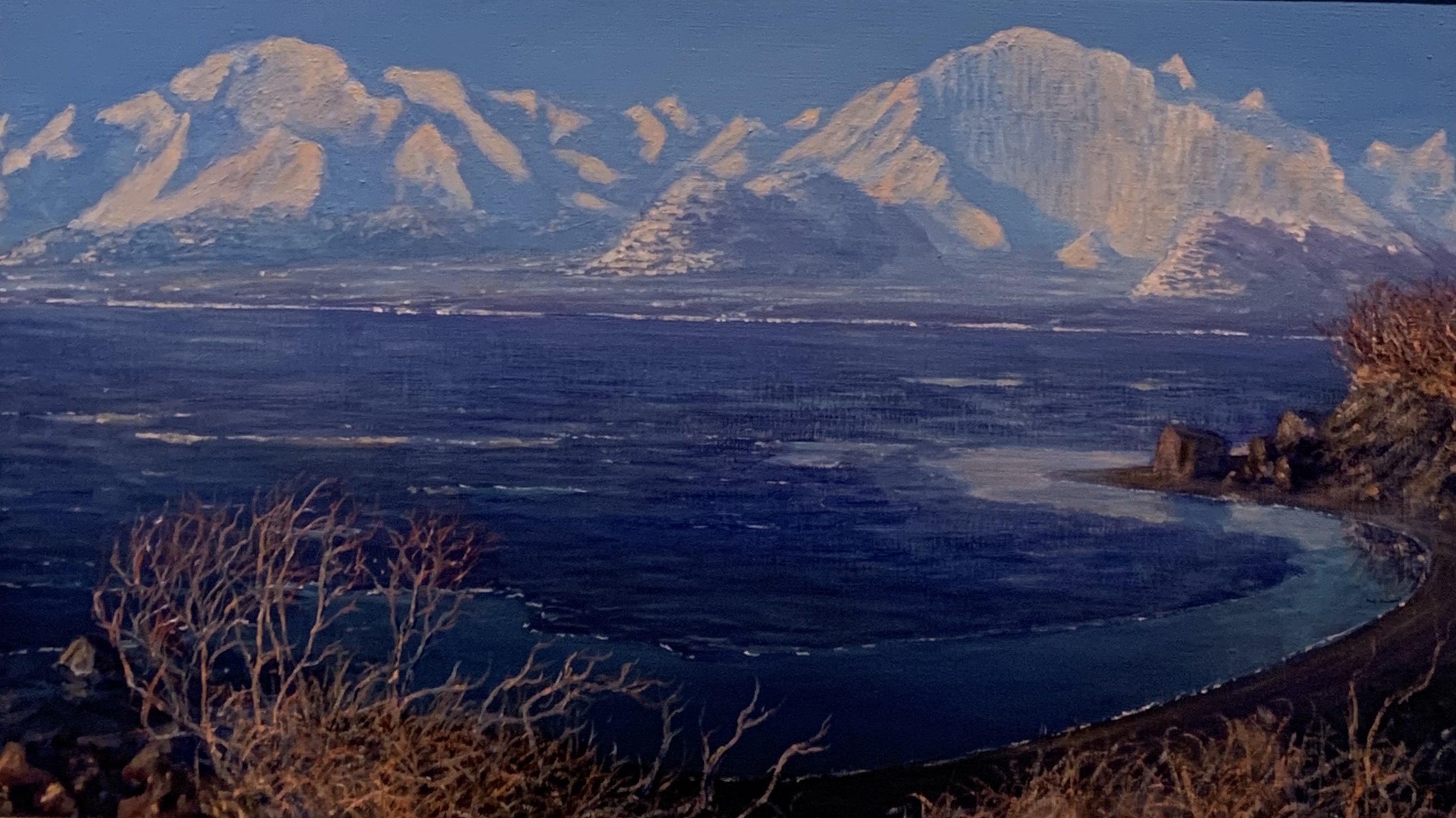
From his perspective as an artist and passion for the environment, Cordova painter David Rosenthal has been creating over the past 45 years paintings of the retreat of global ice at the end of the Ice Age, an age he feels is still in the process of ending.
On Oct. 4, an exhibit of 67 of Rosenthal’s fine art paintings opened at the Anchorage Museum of History and Art, to run through Sept. 14, 2025.
“From my perspective as an artist, I believe the Ice Age is still ending, with vast amounts of ice still locked in mountain glaciers and ice sheets,” writes Rosenthal, in one of several informational pieces that are part of his current exhibit. “Combined, the glaciers and ice fields in Alaska form one of the largest areas of glaciation in the northern hemisphere, but they are just a remnant of the Cordilleran ice sheet that covered much of northwest North America.”
The narrative he includes in the exhibit explains that to create his paintings, Rosenthal relies solely on drawings done in the field, memory and experience.
“For me, the resulting pieces are more real than photographs,” he says. “Photographs may be more accurate, but they are passive recordings of light, gathered from one point in space and from a fraction of a second in time. When I draw a scene, I am actively processing the experience from many points in space and time as my eyes move around, looking into the shadows and then into the light. Colors are adjusted constantly.”
This exhibit, notes Rosenthal, represents his best effort to describe accurately the ongoing retreat of the ice conveying imagined and experienced scenes (from 13,000 BC to 2023), anecdotes from his travels and reflections on ice and glaciers across Alaska, Canada and Antarctica.

“Glaciers surge and retreat rapidly in geological terms, and paintings from my relatively short lifespan show significant changes over time,” he writes in the introductory narrative to the exhibit.
“It might be hundreds, if not thousands, of years before the Ice Age is truly ended, but I feel very lucky to live in this time when I can still experience and paint icy landscapes.”
The exhibit is remarkable not only for the beauty of his work, but for the story it tells of the retreat of global ice over the past 45 years. These paintings are paired with the artist’s reflections, plus perspectives from geologists, oceanographers, biologists and self-taught naturalists.
Rosenthal’s travels have taken him to the Antarctic Continent, Arctic regions, the Greenland Coast, Greenland Icecap, Norway, New England and the Southwest United States. His exhibit at the Anchorage Museum includes work on ice and glaciers across Alaska, Canada and Antarctica.
He sees glaciers as a tool for teaching the public about the impact of climate change, a matter he is quite concerned about.
Originally a physicist, Rosenthal became a self-taught painter and developed an interest northern latitudes and Antarctica. He participated in the National Science Foundation Antarctic Artist and Writer Program as an artist-in-residence at the McMurdo Station during the austral summer of 1993-94 and during the austral winter of 1996. He has participated in efforts of the Artists for Nature Foundation, based in the Netherlands, to promote the conservation of natural and historical landscapes globally.
The current exhibit includes an audio guide, provided by the Anchorage Museum, online.
Featured in the audio tour are Rosenthal’s 2005 painting of Surprise Glacier, Alaska’s mountain ranges, the Columbia Glacier, Sheridan Glacier, Saddlebag Glacier, the Arctic Ocean and Antarctic.
The museum is open from 10 a.m. to 6 p.m. Tuesday through Saturday and from noon to 6 p.m. on Sundays. It is also open for extended hours for First Friday events in Anchorage, with free admission.