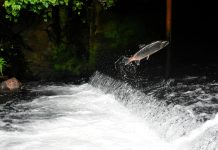
An abundance of fresh coho salmon fillets was available at Costco and Fred Meyer seafood counters in Anchorage this week as the harvest of Prince William Sound silvers rose to a preliminary harvest estimate of 160,171 fish.
As of Sept. 22, the Prince William Sound harvest preliminary total also included more than 5 million pink, 2.8 million sockeye, 1.2 million chum and 9,326 Chinook salmon, according to the Alaska Department of Fish and Game (ADF&G).
ADF&G announced on Sept. 18 that fishing effort was anticipated to be low moving forward and a regular fishing schedule was being established to provide harvest opportunity through the rest of the season.
The Copper River, Bering River and Coghill districts were open for several 36-hour periods, including Sept. 30, Oct. 3 and Oct. 7, and was scheduled to close for the season on Oct. 11. Subsistence fishing was also allowed during those periods.
Overall statewide salmon harvests rose to 96.6 million fish, including 42.2 million sockeye, 37.9 million pink, nearly 16 million chum, 1.4 million coho and 220,000 Chinook.
The 2024 Bristol Bay season summary released by ADF&G on Sept. 17 said the inshore sockeye salmon run of 51.6 million fish was the 10th largest inshore run since 2004 and 7% above the 48.2 million average run for the latest 20-year period, covering 2004 through 2023.

This was also the 10th year in a row that the total inshore run was larger than 50 million fish.
The 2024 run was also 36% above the preseason inshore forecast of 37.9 million fish and runs to every district of the bay were larger than their preseason forecasts.
All sockeye salmon escapement goals were met or exceeded, with a total bay-wide escapement of 20 million fish. The commercial harvest of 31.6 million red salmon was 265 above the 25 million preseason forecast.
The ex-vessel value of salmon caught in Bristol Bay in 2024 was estimated using the price information from final operations reports for each species and average weights from preliminary fish ticket numbers. The preliminary ex-vessel value of $128.1 million for all salmon species was 34% below the 20-year average of $193.4 million. Those prices may not include incentives for icing, bleeding, floating or production bonuses, ADF&G said.
The Bristol Bay summary also noted that this year’s sockeye salmon run was composed of a higher proportion of younger and smaller fish than forecasts. Eighty percent of the 2024 Bristol Bay sockeye run was comprised of fish with two years of ocean growth.
Bristol Bay Chinook salmon harvest and abundance also continued to be low. Chinooks are harvested in Bristol Bay incidentally to the directed sockeye salmon fishing periods. The 2024 Chinook salmon harvests were below the 20-year average in all districts.