
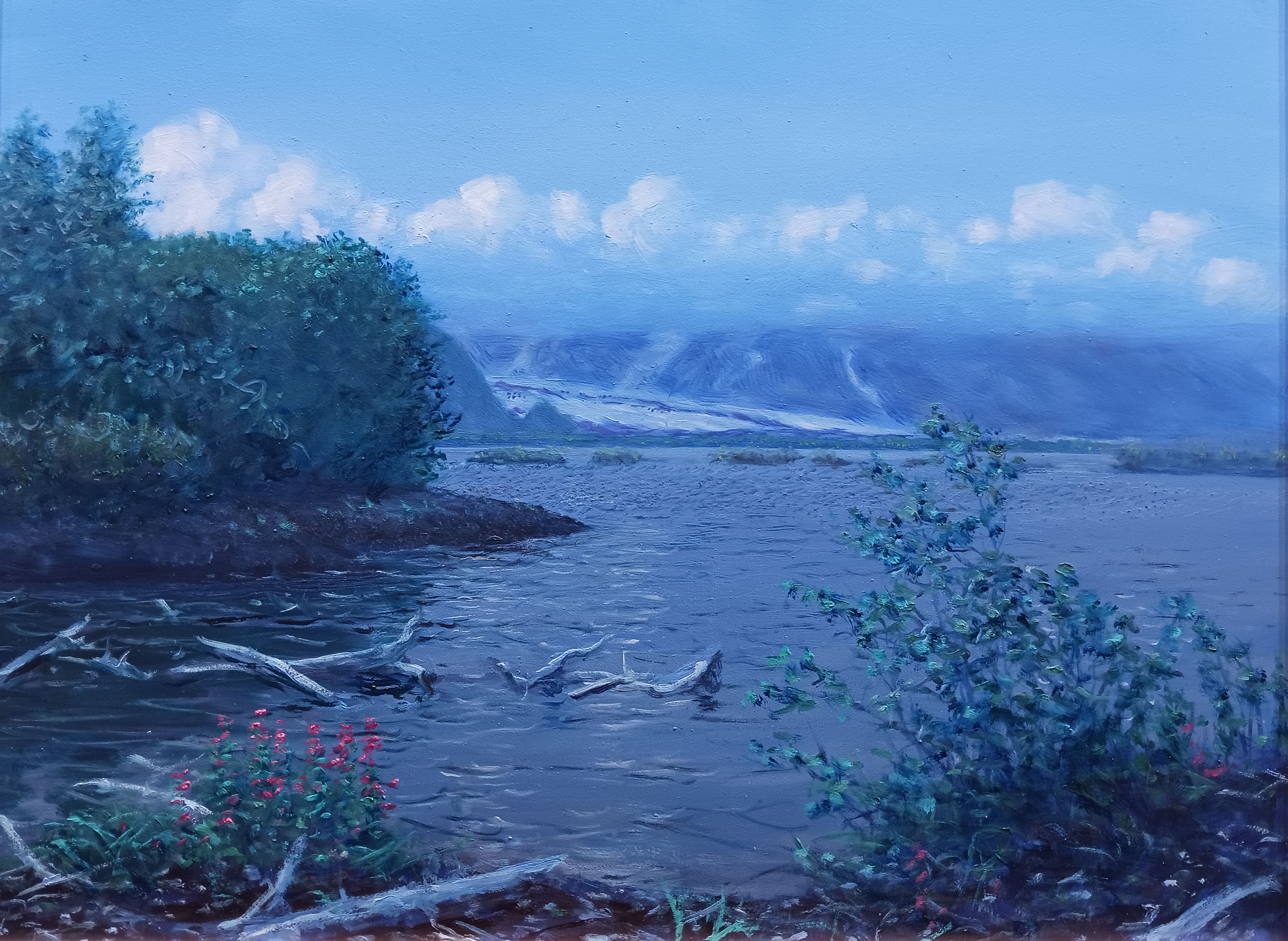
A love of winter and the cold, combined with a passion for studying melting glaciers has compelled David Rosenthal for years to collaborate with scientists to explain how a warming planet may someday mean a world with no glaciers at all.
“About five years ago I started thinking of a science and art exhibit,” said Rosenthal, who grew up in Maine and has been a Cordova resident since 1977. On Oct. 4, an exhibit of his best work on these melting glaciers begins a run at the Anchorage Museum of History and Art.
Rosenthal has spent close to 50 years photographing and painting images of melting glaciers, what he calls the ending of the ice age, and invited some scientists to contribute content on the detailed narratives he provides for his shows. His long-term goal is to have a touring exhibit at natural history museums all over the Lower 48 states.
“It is my major contribution to society,” he said. “I will be updating and editing all the time because things are changing so rapidly.”
Rosenthal arrived in Cordova in 1977 to accept a job working in a cannery, just a year after graduating from college. His degree, as he described it in an interview with the Columbia Climate School in February of this year, “was not very valuable for getting a job, so when I got a chance to go to Cordova, Alaska, to work in a cannery, I took it.” Rosenthal had already discovered an interest in painting but had no time for artwork while working at the cannery. In winter he had plenty of time.
“I was right in the midst of all these glaciers. My work is a chronicle of all this. That’s how I got started,” he said.

His art work today includes water colors and pencil sketches, as well as a number of paintings of Antarctica, the Antarctic Continent, Arctic regions, the Greenland coast, the Greenland Icecap, Norway, and more.
Over the years he has participated in a number of art programs through the Alaska State Artists in Schools program, U.S. Coast Guard and National Science Foundation. The state program brought him to rural villages, where he could teach art to children and also pursue his own work.
In 1988, as part of the U.S. Coast Guard Art Program, he traveled on the icebreaker Northwind north of Spitsbergen, Norway, in the ice of the polar ocean. In return for this unique opportunity, Rosenthal said in an interview with the Alaska State Museum, he painted a view of their ship breaking ice, a painting that is now part of the U.S. Coast Guard art collection. In 1989 he traveled on the Coast Guard icebreaker Polar Star as it escorted supply ships in and out of Thule, Greenland, and then on a diplomatic mission through the Northwest Passage. This trip also produced several paintings that ultimately became part of the Coast Guard collection.
In 1989 he accepted a job with the National Science Foundation as a contractor in Antarctica, a post that resulted in him spending over 60 months on the ice over a decade, including six austral summers and four austral winters. During two of those winters and one summer, he participated in the NSF Antarctic Artist and Writers Program — a program he said was the more important one of all.
In 1999, the last time he was there, as a participating artist at the NSF’s Palmer station he got to travel for four months during the winter around the continent. He did a lot of paintings during those travels which he left at the Palmer station, he said.
Rosenthal has put an extensive amount of effort into the detailed educational panels that accompany each of his paintings in exhibitions, to give more credibility to his work and the increasing impact of climate change. “I’ve worked with scientists my whole career,” he said.
“I’ve always had an environmental streak in me,” Rosenthal said. “What happened was I have become kind of an activist.”
Painting at the End of the Ice Age is all about global warming. “I still do my other work, about the beauty of nature, but not with any specific message,” he said. “This show has kind of taken over, makes me feel that I am contributing.”
Painting at the End of the Ice Age was shown in the Valdez Museum in 2019, enlarged when it came to the Cordova Museum in 2019, and grew again when it came to the Pratt Museum in Homer in 2022. When it came to the Alaska State Museum in Juneau from Nov. 1, 2023 through April 30, 2024, it had again grown and the Anchorage exhibit will again be updated, he said.






