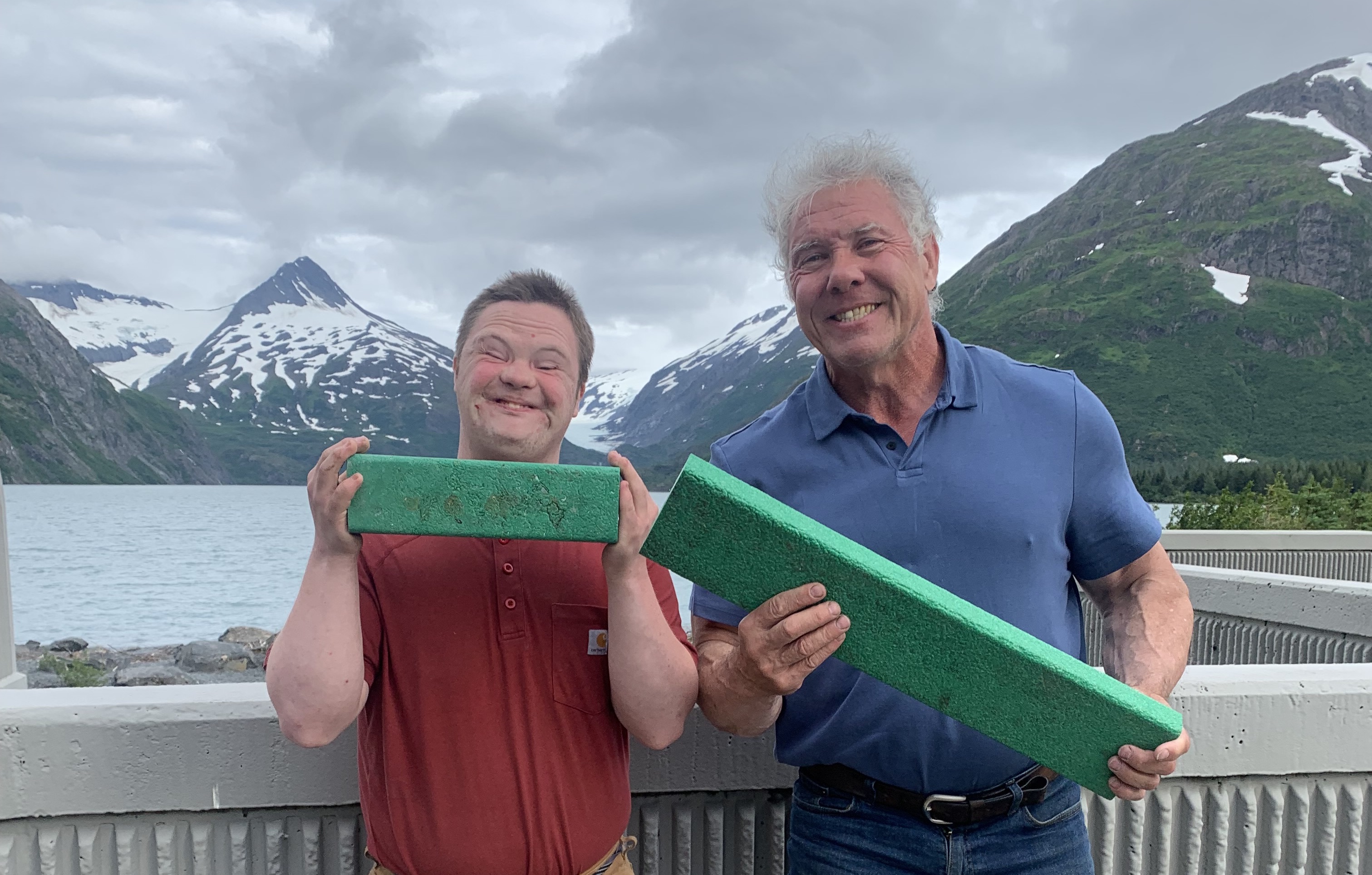
Piles of plastic discards washed up on the vast coastline of Alaska, once destined for landfills, are turning up instead as durable plastic lumber for outdoor construction projects as a product called Grizzly Wood. The product needs no sanding, staining, painting, or waterproofing.
Grizzly Wood is produced by Alaska Plastic Recovery, a subsidiary of PKS Consulting Inc., founded by former Cordova fisherman Patrick Simpson. The product is chemical free, does not absorb water, is rot resistant, and is insect proof.
From the thousands of pounds of plastics collected from the shores of Alaska in a collaborative effort of community and environmental groups, Alaska Plastic Recovery is turning out a variety of plastic lumber used for making everything from signposts, decking and picnic tables to park benches, retaining walls and other outdoor construction projects.
The Homer Trails Alliance on the Kenai Peninsula uses Grizzly Wood on its trail system in the community which bills itself the halibut capital of the world.
Simpson, a fourth generation Alaskan whose grandmother was a member of the Palmer High School graduating class of 1939, was born into a commercial fishing family in Cordova. From 1974 to 1985 he spent summers and most school vacations as a commercial fisherman on his family’s fishing boat. But given an acknowledged issue with seasickness on fishing boats, he opted to pursue a degree in computer science at the University of California in San Diego and embarked on a career with close ties to the fishing industry.
Over the past few years, as he conducted research to refine the process of which plastics to recycle and how to turn them into Grizzly Wood, Simpson has won several large grants from the U.S. Environmental Protection Agency, the U.S. Department of Agriculture, and NOAA.

Now through PKS Consulting and Alaska Plastic Recovery, based in the Matanuska-Susitna Valley, Simpson has built a thriving business, one with a goal of bringing the process of recycling these mounds of plastics into lumber in coastal communities themselves. The idea, said Simpson, is to lower construction costs for these communities by bringing the processing equipment to coastal communities by barge or by road, and producing the plastic lumber right in their own back yard. While the initial cost of that durable plastic lumber will be about double the price of treated lumber, Grizzly Wood will vastly outlast treated lumber and once it is worn out, that Grizzly Wood can be recycled back into plastic lumber up to seven times, he said.
Simpson continues to travel throughout Southcentral and Southeast Alaska to do presentations on how one recycles these plastics into the durable lumber.
He cites government data that shows that in Alaska alone residents generate an average of 23 pounds of plastic per person annually. Government data shows that the typical family uses 220 to 660 pounds of plastic annually, of which only 8% is recycled. Simpson also notes that plastics going into the ocean worldwide add up to between 75 million and 125 million pounds annually.
In 2021 Simpson got a first-hand closeup view of the extent of the plastic waste issue when he traveled to Knight Island in Prince William Sound with the Prince William Sound Stewardship Foundation, based in Girdwood. There he saw layers of plastic waste heaped up on the shore. The amount of those plastics is so huge that communities like Ketchikan, Petersburg, Sitka, and Wrangell bale up all such waste and ship them for disposal in Oregon, he said.
After careful research, Simpson came up with a formula that uses three varieties of plastics to produce Grizzly Wood: #1 polyethylene terephthalate (PET/PETE), #2 high density polyethylene (HDPE), and #5 polypropylene (PP). Tossed into a grinder and then extruders, the company transforms the garbage plastics first into tiny plastic beads and from there into plastic lumber.
PET/PETE plastic is a clear, hard plastic often used to make single-use food and drink containers, from water bottles to peanut butter containers. HDPE plastic containers are used for household cleaners, buckets, shampoo bottles, and yogurt containers. PP plastic is commonly used for caps, some yogurt containers, medicine bottles, and straws.
Simpson has also found another ready source of plastics to recycle from Hillcorp, which uses large plastic caps made of very durable plastic for pipe-thread protectors to protect the ends of drilling pipes in Alaska’s North Slope oil fields. For well over a year now, Hillcorp has been delivering the used plastic caps to Alaska Plastic Recovery headquarters in Palmer.
The Homer Trails Alliance (HTA), one of a growing number of Alaska Plastic Recovery’s customers, said they have used Grizzly Wood successfully in two different applications.
They first employed the plastic wood as underlayment for a product called Geoblock, which is used to span walkways through wetlands. In that application Grizzly Wood serves as a mailer at each panel’s seam and helps to float the Geoblock, preventing it from sinking into the bog, said Billy Day, a board member of HTA.
“We then fill and cover the cells with wood chips providing a firm, dry trail surface across wet ground,” he said.
Past installations have used plywood for this purpose and it has rotted away over a few years. HTA anticipates in this application that Grizzly Wood will last indefinitely as it is not exposed to either sunlight or the wear and tear of foot traffic, Day said.
Given that success, HTA then opted for a test project, using Grizzly Wood to construct 200 feet of boardwalk across a notoriously bad section of wet trail. For this project they used 4×4 lengths of Grizzly Wood over salvaged steel shipping crate frames to construct the foundation and covered them with 2×6 decking. After a couple of months, the Grizzly Wood appears to be holding up well, even with the occasional traffic from ATV maintenance equipment, Day said. Due to the high density of the Grizzly Wood, HTA expects the plastic product to hold up well for the long term, he said.